Filed this cycle
From Card Catalog to App: How the Anna Library Bridges Two Eras
Analog patience meets digital reach.
Words by Yvonne Turner
Analog-to-Digital Life & Caregiving Correspondent · Xennial lens
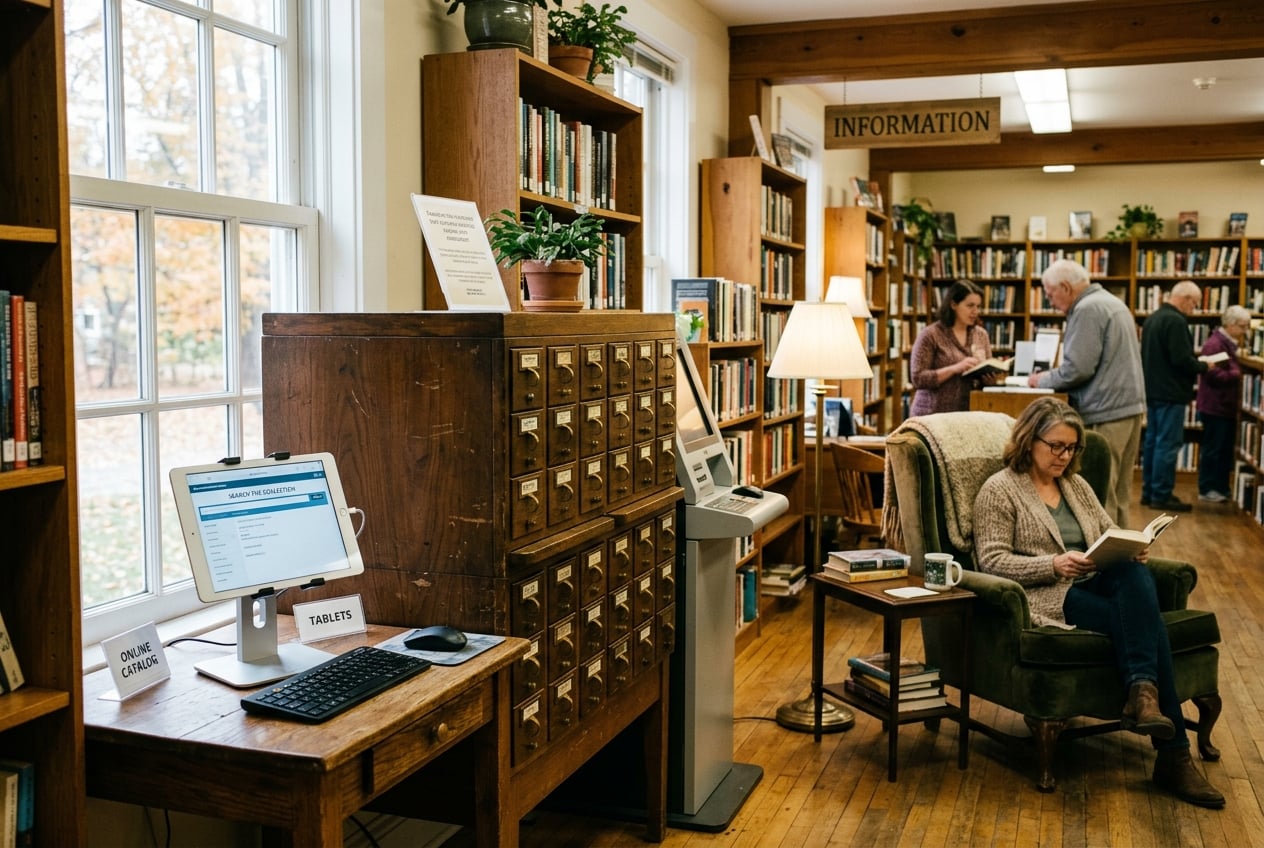
Photograph · Anna LIFE Photo Desk · composed by Sierra Grace
Some buildings teach you how a town thinks. A library does that quietly.
You can feel the older rhythm first. The door opens, the air changes, and voices drop without anyone being told. A child leans over a picture-book bin. Someone stands at a shelf long enough to read spines with one finger tilted against the row. A grandparent asks for help finding a large-print title. The work is slow in a useful way. Not delayed. Just human-speed.
Then the newer layer comes into view. A phone lights up with a library app. An e-book lands on a screen after bedtime. An audiobook starts in the pickup line on [NEEDS: a common Anna road or school pickup context if verified]. A hold gets placed while dinner is in the oven. The same public promise is still there: if you want to learn, read, look for work, help your kid, understand a form, or sit somewhere that asks nothing from your wallet, this place is for you. Only now some of that access travels home in your pocket.
That shift matters in a town like Anna, where growth can make ordinary errands feel like strategy. Families are balancing school calendars, commutes, sports bags, appointments, and the small care tasks that eat a day whole. Adult children are helping parents reset passwords, refill prescriptions, and figure out why the patient portal suddenly wants a code from a text message. Kids can swipe before they can tie a shoe, but they still need help choosing what is worth their attention. The library sits right in the middle of that handoff between paper habits and digital systems.
For some residents, the bridge is literal. They remember card pockets, date stamps, and the satisfying little thunk of a drawer sliding open. They trusted systems they could see. For others, the first interaction may be digital: browsing a catalog online, renewing from a phone, checking whether a title is available before leaving the house. Neither method is more serious than the other. One offers touch and time. The other offers reach.
The good library work is in the translation.
A staff member explains how to search the catalog without making anybody feel behind. A parent learns there is a digital option for a child who burns through books faster than a weekly visit can cover. Someone new to town finds programs, resources, or a quiet table. Someone older discovers that an audiobook can make a long afternoon easier on the eyes. Somebody who does not want another app on their phone is still allowed to just come in, ask a question, and carry home a stack of real books.
That is the part technology cannot replace: the calm person on the other side of the desk. Not a chatbot. Not a help article. A human being who can say, try this, let me show you, you are not the first person this has happened to.
Libraries have always been full of tools. We just changed the shape of some of them. A reference shelf becomes a database. A bulletin board becomes a website and social feed. Story time still depends on a real lap, a real rug, and a room willing to be cheerful together. The form changes. The trust should not.
What lasts across both eras is simple. The library is one of the few places left where curiosity is enough reason to enter. You do not have to optimize your visit. You do not have to buy your way in. You can come for a printer, a novel, a program, a question, a little AC in the Texas heat, or the small relief of being helped without being rushed.
In a fast-growing town, that kind of continuity is not old-fashioned. It is infrastructure.
About this byline. Yvonne Turner is a correspondent on the Anna LIFE Generational Press Desk, writing with a xennial lens perspective and published by TownSquare App Press with human editorial review. Stories are grounded in real Anna, Texas life; always confirm time-sensitive details (dates, rates, deadlines) with the relevant office before acting.