Filed this cycle
Sunday Suppers: Anna's Longest-Running Church Potlucks
Where newcomers are fed before they are known.
Words by Marion James
Front Porch, Legacy & Service Correspondent · Baby Boomer lens
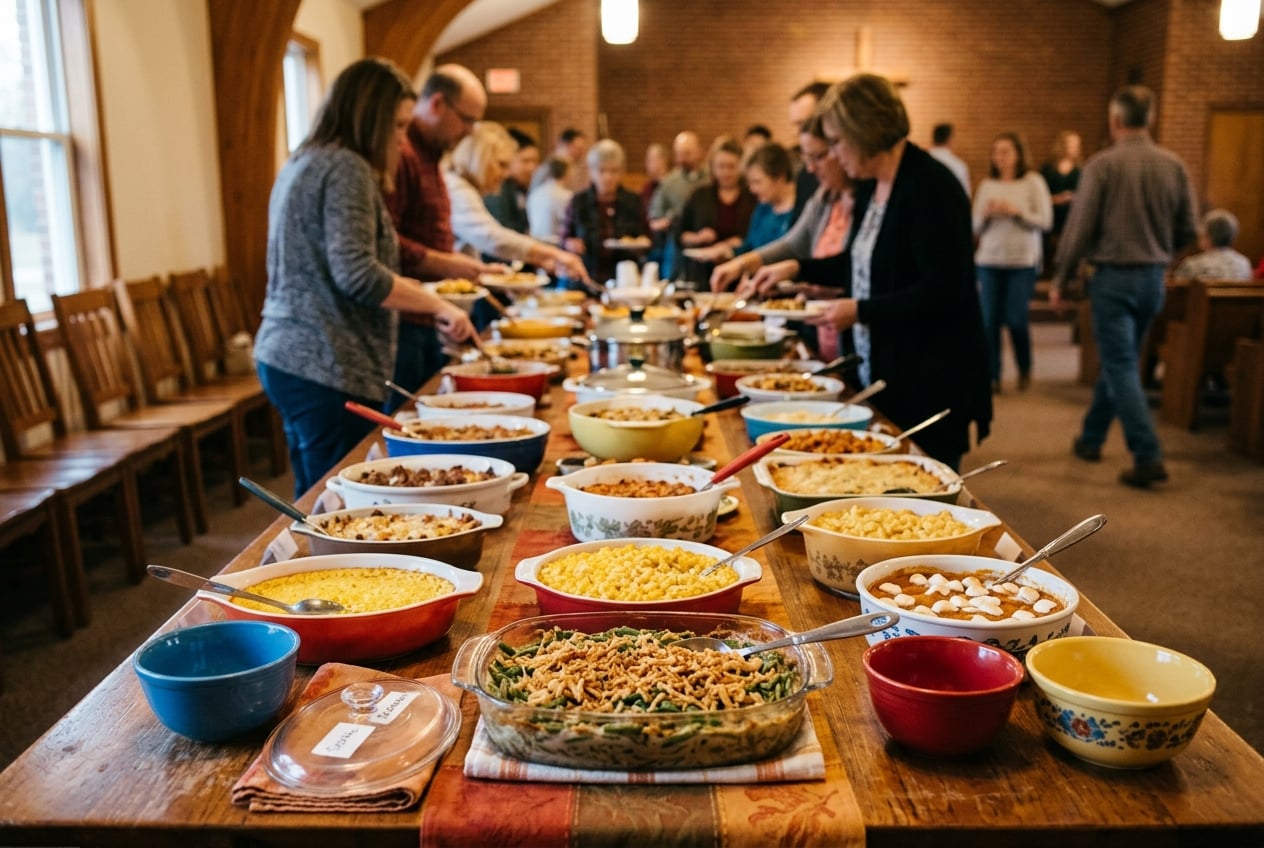
Photograph · Anna LIFE Photo Desk · composed by Sierra Grace
By late Sunday afternoon, the light in Anna turns soft on the parking lot stripes and the church fellowship halls begin to smell the way memory smells here: yeast rolls sweating under a towel, green beans gone tender in a slow cooker, banana pudding settling in a glass dish. A long table takes the weight of casseroles and sheet cakes. Folding chairs scrape the floor. Someone is still bringing in tea.
A church potluck is not fancy food and never needed to be. It is food made to stretch, food that can wait an extra ten minutes if the preacher visits too long at the back door, food that forgives a child for taking the corner piece first. It is also one of the few places left where a person can arrive unknown and be handed a plate before anybody asks where they came from.
That order matters.
In a growing town, people learn one another in fragments. A face at the gas station. A wave from a new driveway. A child in a school shirt you do not recognize yet. But around a serving line, the introductions come easier because hands are busy. You ask, "Did you make the cobbler?" and one thing leads to another. Before long, somebody is pointing out whose grandmother used to bring the same dish, who just moved to town, who has a mother recovering at home, who needs an extra plate carried out after the blessing.
Older Anna families know these meals as part of the town's real ledger of care. Not the public record. The private one. Who fed mourners after a funeral. Who packed up leftovers for the widower. Which Sunday school class kept paper goods in a closet because there would always be one more gathering than expected. Churches have marked the seasons this way for a long time, with supper rooms that hold both celebration and burden. [NEEDS: name of one or more Anna churches with a long potluck tradition, if verifying for print]
The menu tells its own local history. There are dishes that arrived from farm kitchens, built from pantry staples and garden surplus, and there are the newer additions that came with families from elsewhere, set down on the same table without ceremony. Deviled eggs beside [NEEDS: a verified example of a dish commonly seen at Anna church potlucks today]. Cornbread beside [NEEDS: another verified dish example]. No one needs a speech explaining change when change is already passing the serving spoon.
And still, some things do not change much. The women and men who seem to know where everything is kept. The person in sensible shoes wrapping foil over a half-pan for someone who had to leave early. The children released from pew manners, weaving between knees with a cookie in hand. The blessing said over enough food for more people than expected, which is usually about right.
It would be easy to turn this into nostalgia and call it simpler than it was. It was never simple. Church kitchens have always run on labor, planning, and somebody staying late to wipe down tables after everybody else is gone. They have reflected the town's joys and its strains. Potlucks do not erase loneliness, or grief, or the awkwardness of being new. But they give those things a place to sit.
That may be why these suppers endure when so much else has sped up. You do not need a reservation. You do not need the right story about yourself. You carry what you have through a side door, set it down among the others, and make room. In Anna, that kind of welcome has long been one of the plainest forms of service. Not performative. Not polished. Just a warm plate balanced in two hands, and a voice saying there is plenty if you would like some more.
About this byline. Marion James is a correspondent on the Anna LIFE Generational Press Desk, writing with a baby boomer lens perspective and published by TownSquare App Press with human editorial review. Stories are grounded in real Anna, Texas life; always confirm time-sensitive details (dates, rates, deadlines) with the relevant office before acting.