Filed this cycle
The Families Who Farmed Anna Before the Boom
Legacy landowners on what the fields remember.
Words by Marion James
Front Porch, Legacy & Service Correspondent · Baby Boomer lens
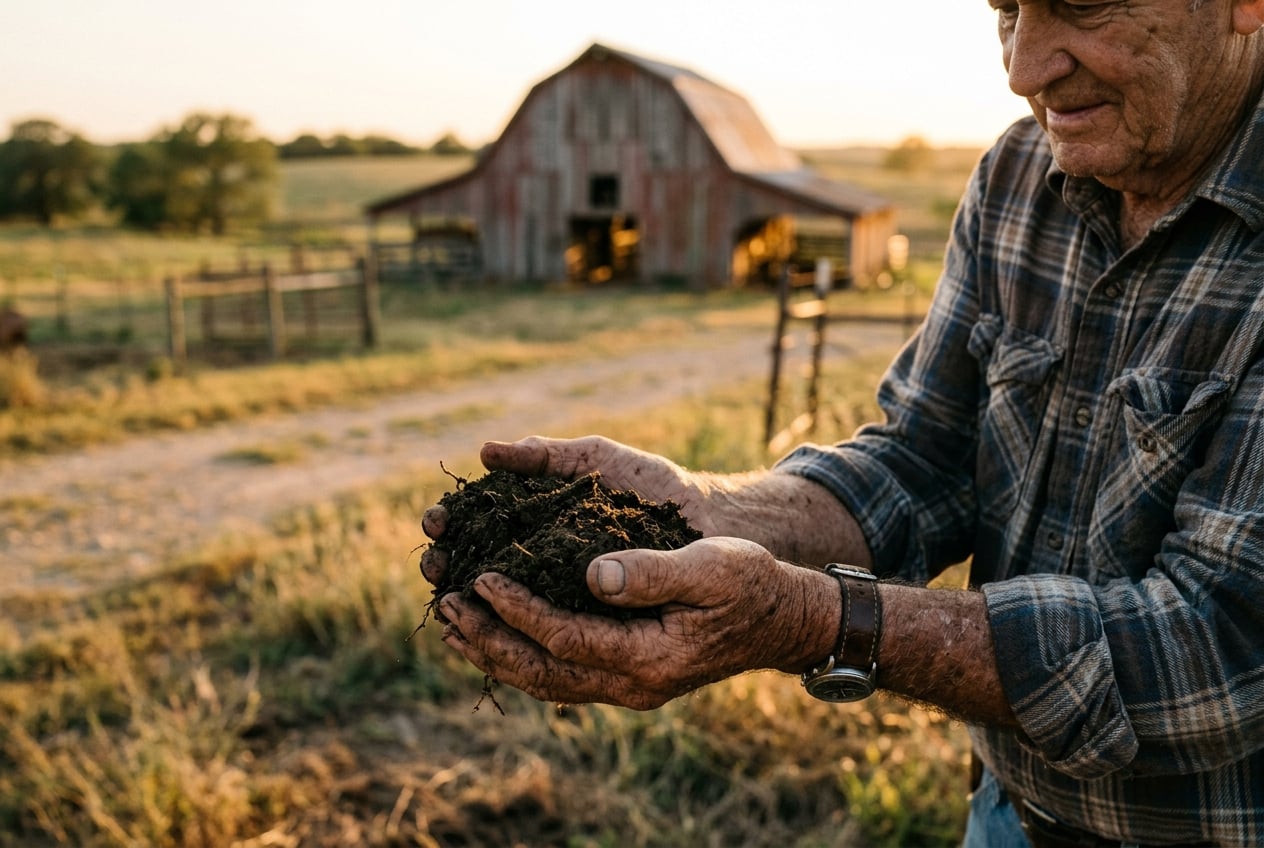
Photograph · Anna LIFE Photo Desk · composed by Sierra Grace
On certain mornings, before the traffic gathers itself and the school zone lights begin to blink, you can still catch the shape of the older Anna. It sits low to the ground. Fence lines. A stand of trees that never moved. A pond holding the color of the sky. A stretch of field that looks empty until you understand how much work an empty field can hold.
The people who farmed here before subdivisions, before retail pads, before the town began to fill in around old county roads, learned the place by repetition. They knew where water would stand after a hard rain and which patch would dry first. They knew what a north wind could do in January and what a week of August sun could take out of a man, a crop, or a cow. They knew the sound of gates, the weight of feed sacks, the patience required when a machine quit at the wrong hour.
Some of those families are still here. Some sold land in pieces over time. Some watched acreage pass out of the family after illness, debt, age, or the simple fact that children built lives in other kinds of work. There is no single story that covers all of it. Land can be a blessing, an argument, an inheritance, a burden, and the plain ground under your feet, all in the same lifetime.
If you ask legacy landowners what the fields remember, they are not likely to answer in grand language. They might point instead to labor. To days that began in the dark. To women who kept books, cooked for crews, raised children, and worked right alongside everybody else, though history has a habit of leaving their names in the margin. To storms that split a season in two. To lean years no one advertised. To good years that were never as easy as they looked from the road.
A field remembers use. Not just ownership. It remembers furrows, hooves, tires, seed, drought, and waiting. It remembers boys and girls learning early that chores come before comfort. It remembers a father checking the horizon and saying little. It remembers a mother rinsing dirt from vegetables in the sink. It remembers the long ordinary chain of tasks that made a living where there was no clock to punch and no promise the year would come out even.
The newer Anna is not false just because it is new. Families arriving now are making their own honest claims on this place. They are unpacking kitchen boxes, finding churches, sitting in pickup lines, coaching ball teams, and learning which way the wind hits on a cold evening. That matters too. But if we want to understand the ground under the growth, we ought to listen for the older knowledge that does not always speak loudly.
A paved road can cover a path, but it cannot erase it. Behind a row of houses there may be a creek line somebody’s grandfather crossed in mud. Near a detention pond there may have been cattle once. At the edge of a development sign, there may still be a gatepost set by hand. These are not reasons to resent change. They are reasons to tell the truth about what came before it.
What built Anna was not only vision, and not only opportunity. It was endurance. It was families staying with work that was physical, uncertain, and necessary. It was people who measured wealth in rain, time, usable land, healthy animals, and children who knew how to help.
The fields may be divided now, surveyed, poured, framed, and roofed. Even so, the old ground keeps its memory. You can feel it in the flat light over open acres [NEEDS: a specific surviving road, area, or landmark in or near Anna where legacy farmland is still visible], in the names still spoken by older residents [NEEDS: verified names of legacy Anna farming families willing to be included], and in the quiet knowledge that a town does not start when the boom arrives. It starts with the people who kept showing up to the land when nobody was watching.
About this byline. Marion James is a correspondent on the Anna LIFE Generational Press Desk, writing with a baby boomer lens perspective and published by TownSquare App Press with human editorial review. Stories are grounded in real Anna, Texas life; always confirm time-sensitive details (dates, rates, deadlines) with the relevant office before acting.